
The Asociación Española de Especialistas en Medicina del Trabajo (AEEMT), founded in 1983, has been an essential pillar for the unity and defense of the interests of specialist physicians in this medical field. Its commitment to building a specific body of doctrine and adapting to current challenges is reflected in its events, such as the recent Intercongress Meeting.
The Intercongress Meeting in Málaga was a resounding success, attended by around 100 professionals. Challenges in health assessment, workplace adaptation and legal aspects were addressed. The roundtable sponsored by Laboral Group on artificial intelligence and the metaverse in occupational medicine.
Pilar Fernández-Fígares Vi, National Coordinator of Health Services at Grupo El Corte Inglés, played an essential role in hosting and presenting the congress. Her collaboration and support made it possible to share the perspective of Carlos Pascual, director and consultant in Retail and People Analytics, on the Applications of Big Data and People Analytics in Occupational Medicine. He introduced key concepts, highlighting the importance of Data Science as a discipline that combines technical and business knowledge to support decision-making in medical organizations.
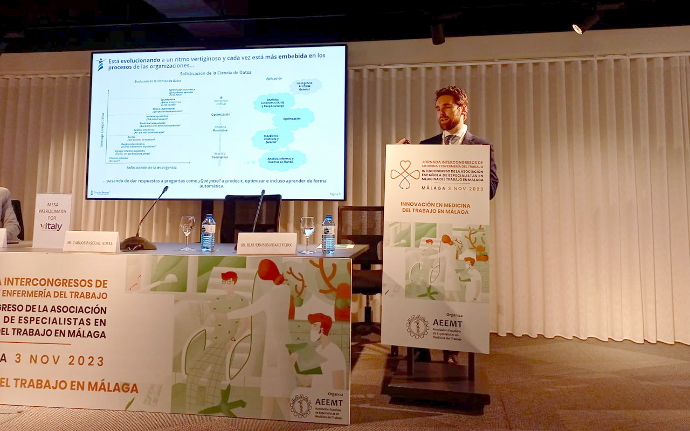
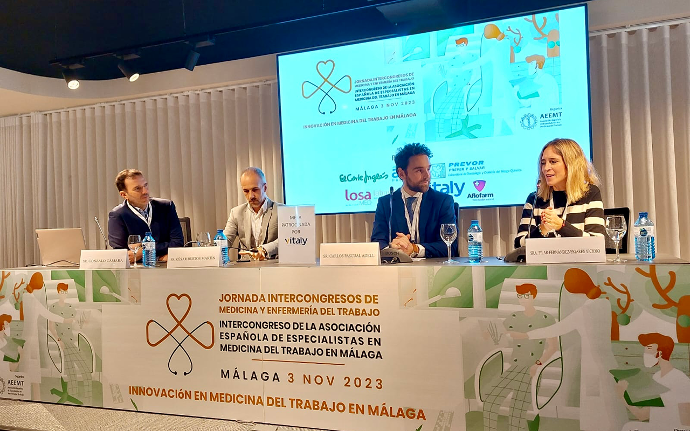
In his presentation, he listed the challenges and opportunities involved in applying data science to occupational medicine. He noted that, despite the maturity of this discipline in clinical research, occupational medicine is in the early stages of implementing these techniques. He emphasized the importance of building multidisciplinary teams that bring together engineers and data scientists with specialists in specific areas. He also underlined the ethical and legal complexities associated with the processing of medical data protected by the General Data Protection Regulation, stressing the need to guarantee and justify added value in corporate projects.
The practical case presented by Carlos Pascual, the COVID-19 Observatory, tangibly illustrated the successful application of data science in the workplace. This observatory, created in collaboration with the Occupational Risk Prevention team and the Advanced Analytics Center, not only monitored the progress of the disease, but also served as a key tool for negotiation at the institutional level. The presentation of monthly reports and the analysis of various KPIs showed how a representative sample of society can generate extrapolable conclusions, demonstrating the opportunities offered by Data Science and Big Data in occupational medicine.
The AEEMT Intercongress Meeting in Málaga was a milestone in the reflection on and evolution of Occupational Medicine, linking the present event with the upcoming 13th Spanish Congress of Occupational Medicine and Nursing in Cartagena, February 22 to 24, 2024. Innovation and a commitment to continuous improvement mark the path toward the future of this specialty.
To learn more about the news and advances in this medical specialty, we encourage you to follow AEEMT on its social media.