
Do you have a business and haven't clearly defined your mission, vision and values?
Mission, vision and values are the pillars on which a business is founded, a statement of intent and a calling card that reminds both our customers and our team: What situation do we want to improve? (mission), What would things look like if this situation improved? (vision) and What drives us to do it? (values).
These elements are key in the strategic dimension of any Business Plan and must be considered in the decision-making process to ensure integrity and coherence.
Mission defines strategy, and strategy defines structure.
Despite their notable importance, there are a large number of companies, especially SMEs, that have not defined these sections. That is why we have prepared the following post, in which we detail the concepts, explain how to develop them, and provide some resources as well as examples to make their development easier.
What are a company's mission, vision and values?
What is a company's mission?
To correctly define a company's mission, we have to answer the following question: What situation do we want to improve? The mission is the answer to this question and can take the form of:
- Solving a specific problem or improving people's quality of life through a new product or service.
- Improving, simplifying or lowering the cost of the way certain products or services were offered.
- Extending an existing product or service to a segment of the population that did not have access to it.
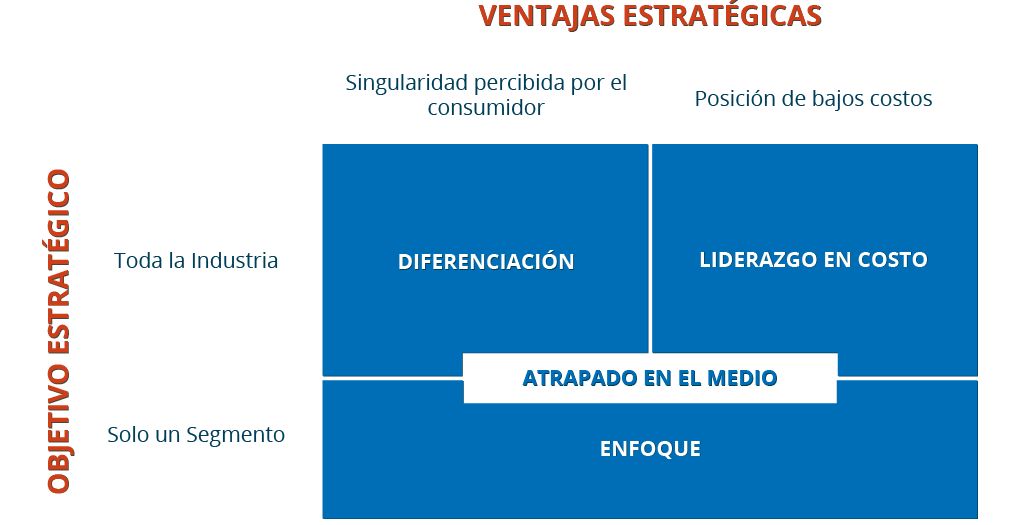 Competitive advantage according to Porter
The mission explicitly contains the Value Proposition, the differentiating factor that justifies why a potential customer should buy your Offer, whether a product or a service, or that of your competition, which also opens the way to talking about Competitive Advantage and Market Positioning.
Competitive advantage is about being different. It means deliberately choosing a different set of activities to deliver a unique mix of Value.
What is business vision?
Vision helps us project ourselves into the future by describing what the situation would be like: What would the world be like if the situation targeted by our mission improved? There is no better example of vision than Martin Luther King's speech on August 28, 1963, in front of the Lincoln Memorial, in which he explains how he would see the world if the mission he fights for were someday fulfilled.
So even though we face the difficulties of today and tomorrow, I still have a dream. It is a dream deeply rooted in the American dream. I have a dream that one day this nation will rise up and live out the true meaning of its creed: "We hold these truths to be self-evident, that all men are created equal."
The path from your mission, your current situation and the process to resolve it, to your vision, the ideal future situation, must be aspirational but achievable. For this, the best approach is to define Objectives, Goals and Milestones:
- Goals: a set of abstract objectives that still lack definition.
- Objectives: concrete and measurable, following the SMART philosophy: Specific, Measurable, Attainable, Relevant, Time Based
- Milestones: a set of objectives that share a deadline.
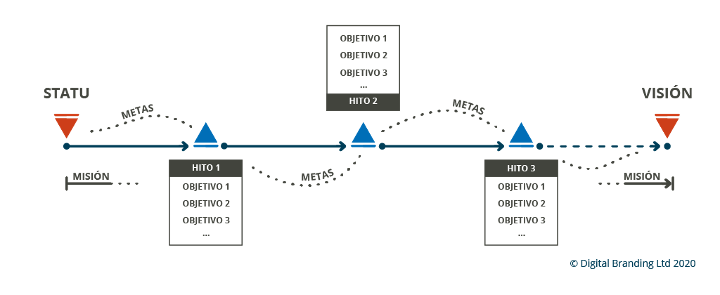
Relationship between Mission, Vision, Goals, Objectives and Milestones
If you are interested in methodologies for defining and specifying objectives, we recommend reading the methodology of Andy Grove, the Father of OKRs, which is masterfully explained in the book Measure What Matters by John Doerr. This methodology, which was born at Intel and helped make it the giant it is today, details a simple yet robust way of building objectives and incorporating them into the business.
What are a company's values?
A company's values are the ethical principles on which its culture is based, and they answer the question: What drives us to fight to achieve our vision? They also define the way we relate to our environment: customers, suppliers, competitors.
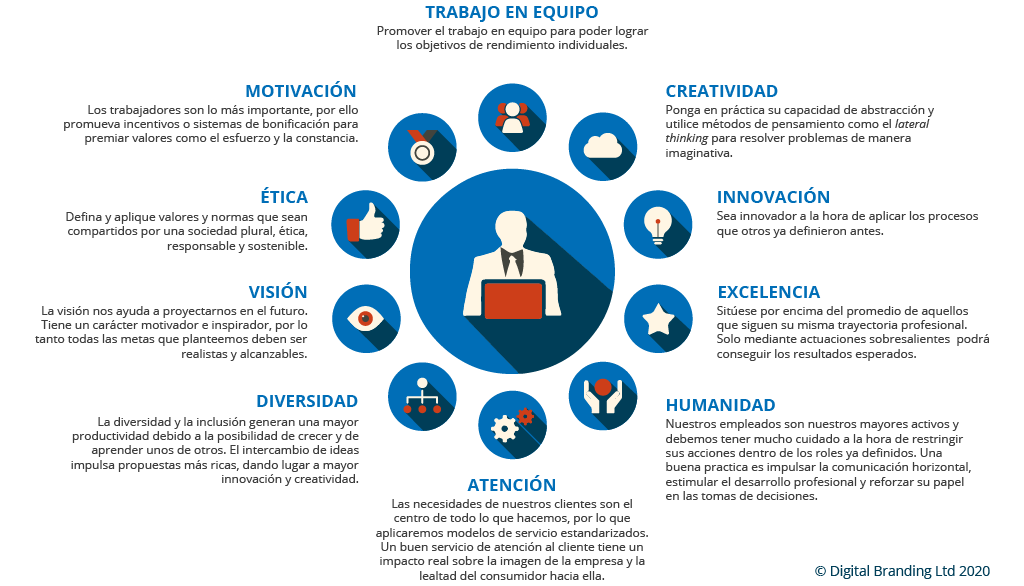 Corporate values
Values in an organization tend to be projections of the founders' values, and as the company scales, a two-way phenomenon occurs in which values permeate down through the corporate hierarchy but also in reverse, acting as a reflection, scaling from the base up to the top.
Ultimately, the perception of a firm's values is the sum of the values of each of the employees who make up the organization. At this point, Leadership could be defined as management's ability to align its values with those of its team in order to reach the same goal (vision) together.
Personal leadership is the process of keeping your vision and values before you and aligning your life to be congruent with them.
Why is it important to have your mission, vision and values well defined?
As you have seen, these concepts are decisive in any strategic decision. Communicating our strategic positioning and acting accordingly guarantees integrity in action and respect from customers, employees, suppliers and competitors. Below, we have selected a series of examples that illustrate these pillars in detail:
Mission
- Google Mission: To organize the world's information and make it universally accessible and useful.
- Apple Mission: To design the best personal computers in the world, lead the digital music revolution and define the future of mobile media.
- Adidas Mission: To lead the sporting goods industry with brands based on a passion for sport and the sporting lifestyle.
- Microsoft Mission: To empower every person and every organization on the planet to achieve more.
- Singular Beacon Mission: Our mission is to help companies reach their full digital potential
Vision
- Google Vision: A world in which everyone has access to information in a single click
- Apple Vision: Challenge the status quo.
- Adidas Vision: To be leaders in innovation and design that help athletes of all skill levels achieve maximum performance with every product we bring to market.
- Microsoft Vision: To help people and businesses throughout the world realize their full potential
- Singular Beacon Vision: A world in which new technologies are a tool that helps improve productivity and reach new horizons.
Values
- Google Values: learning, success and inclusion.
- Apple Values: excellence, focus, development and innovation.
- Adidas Values: safety, collaboration and creativity.
- Microsoft Values: Innovation, diversity and trust.
- Singular Beacon Values: Price-Value Ratio, Results Orientation, Honesty, Loyalty, Flexibility
Conclusion
In this article we have reviewed the concepts of mission, vision and values, as well as other related concepts such as Porter's Competitive Advantage, the difference between milestones, goals and objectives, and their practical application through Andy Grove's OKR technique. We have also compiled five practical examples of these pillars to make them easier to understand.
At Singular Beacon we can help you define all these concepts for your brand and build your business plan. Contact our Digital Marketing team at the phone numbers you can find in our contact section.