
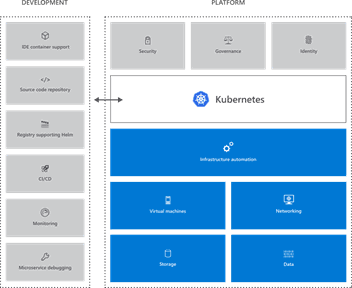
Kubernetes is a container or microservices platform that orchestrates workloads across storage, network and compute infrastructure. Because it does not limit the types of applications it can deploy (any language works), Kubernetes extends the way we scale containerized applications so that we can enjoy all the benefits of a truly immutable infrastructure. The rule of thumb for K8S: if your application fits in a container, Kubernetes will deploy it.
What are the benefits of Kubernetes?
Fewer resources, cost savings
More containers can be deployed on the same host than with traditional virtual machines. The demands on the startup process and disk space are lower and faster.
Simpler IT management, higher IT productivity
Containerization lets you standardize your deployments, since they are repeatable environments for development, testing and production tasks. Compatibility with all deployment systems eliminates valuable setup time. They are fully portable items. With Docker, deployment takes seconds.
Several independent applications on the same host
Each application runs in its own container or container cluster independently, without conflicting with the other applications hosted by the host, which will run through their own containers. This ensures a secure and efficient environment.
Docker and Kubernetes
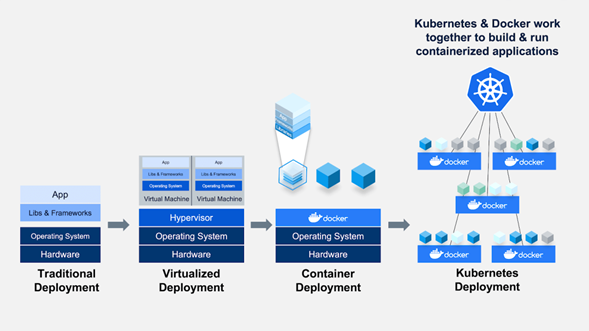
Docker is a lightweight containerization technology that has gained great popularity in the world of application packaging and the cloud. It is an open-source framework that automates the deployment of applications in lightweight, portable containers. It uses a number of Linux kernel features to turn sandboxed processes into configurable virtual environments.
Docker is used to run software packages called "containers". A container is a standardized unit of software that bundles code and all of its dependencies, so the application runs quickly and reliably from one computing environment to another. Containers are the "innovation technology that enables the fastest-developing cloud", since they speed up software delivery and reduce workload costs. Software composition is faster, delivery is simpler, and running it requires less equipment and support.
Kubernetes uses Docker to run images and manage containers. The platform itself can be deployed within practically any infrastructure, such as Google Cloud, Microsoft Azure, AWS or a private network. It is worth noting that Kubernetes supports the automatic placement and replication of containers across a large number of hosts.
It comes with a series of features that can be regarded as:
- Container platform
- Microservices platform
- Portable cloud platform and much more
These are the essential features of Kubernetes:
- Offers automated scheduling
- Self-healing capabilities
- Automated rollouts and rollbacks
- Load balancing and horizontal scaling
- Application-centric management
- Auto-scaling infrastructure
- Can create a predictable infrastructure
- Provides declarative configuration
- Deploy and update software at scale
- Offers environmental consistency for development, testing and production
How do we implement Kubernetes at Singular Beacon?
Kubernetes has become a standard for container management, providing the resources needed to efficiently manage containerized applications at scale.
At Singular Beacon we have bet on this technology for deploying our web services, such as websites, databases, web applications or hosting, making use of the advantages of autoscaling and monitoring, and allowing us to offer our clients 100% uptime of their web solutions and a minimization of security flaws.
Modern cloud-native architectures are on the rise, but at the same time they bring new challenges, which makes this a technology with a great future.
Start writing here...